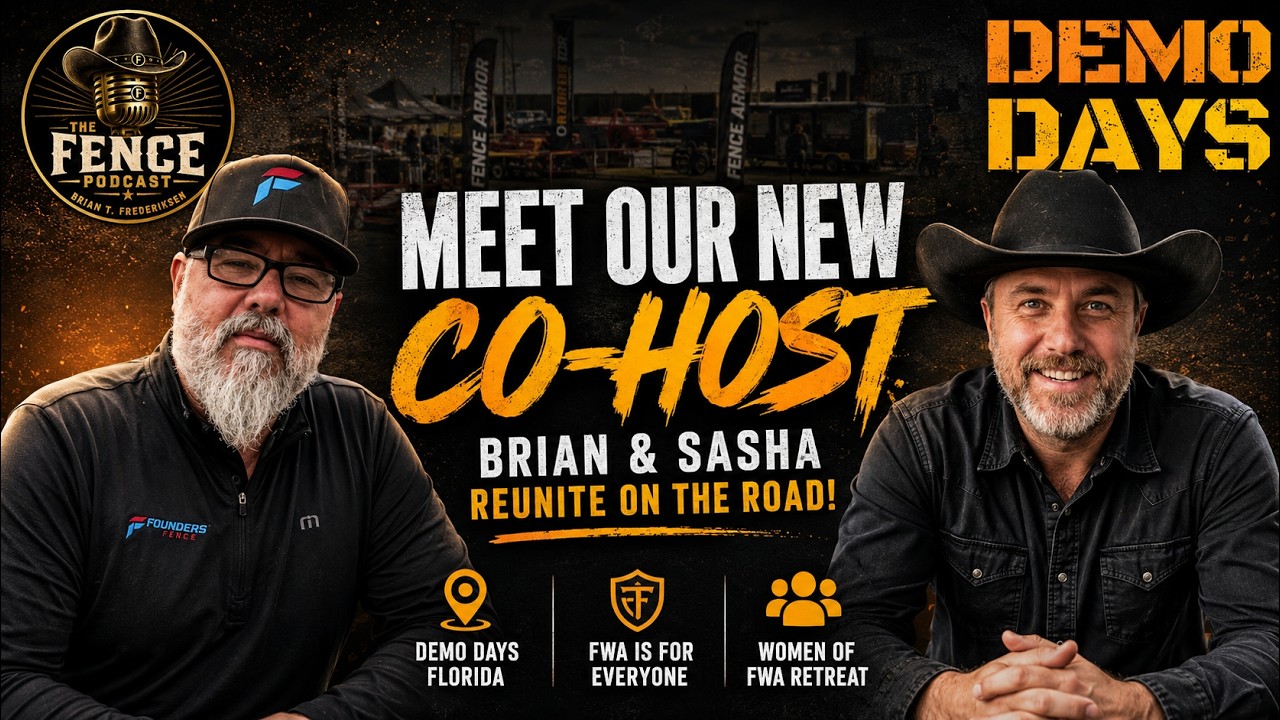
Women of FWA Hard Questions and the State of the Fence Industry
The episode opens with Chris and Desiree of Angley Staining sharing how their Texas-based husband-and-wife business grew from necessity during COVID into a focused fence and staining company. Chris explains that a cancer diagnosis, military background, and job loss forced major life changes, while Desiree helped narrow the business into a niche built around high-end fence installs and pre-staining. They describe their progression from small, low-ticket stain jobs to a more established operation with larger average tickets, stronger branding, and a growing interest in training, better materials, and multi-location expansion. Desiree also highlights the role women can play in the industry through marketing, customer care, branding, and creativity, and both praise the Women of FWA community as a welcoming support network. The conversation then shifts into a candid, sometimes tense discussion of industry organizations, podcasts, and show politics. Brian argues that the fence industry is too small to treat associations and events as zero-sum competition, emphasizing that multiple groups can coexist and that the real goal should be protecting small business ownership, education, and industry access. He says the Fence Workers Association exists to give contractors a voice and keep the industry open, while still supporting other shows and organizations like Fence Tech. The panel also discusses how social media and podcasting have become important tools for awareness, though commercialization and funding can influence messaging. Overall, the episode frames unity, transparency, and expanding participation as the most important priorities for the fence industry.
Topics Discussed
Chapters & Key Moments
Full Transcript
(18,828 words)Hey,
Hey.
Yeah. Does that not get you excited or what? That was legit. Hey, so we got Chris and his boss Desiree here today. Kit ourselves. So, this is really cool because I mean, everybody loves you. I think the first time I really met you guys was at the fence show this uh this last year coming up. So, uh that was really cool. Um tell everybody that doesn't already know you though a little bit about you guys and uh about Angley Sing. Yeah. So, um we're based out of New Browns, Texas. We've been doing this for about four years. We're the small shop. We're in between San Antonio and Austin. So, we hit up both places. Um, we're a husband and wife team. We tend to focus on uh high-end. So, our minimum standard is 6 in cedar pickets with metal post. We don't go anything lower than that. And standard wise uh composite composits a big one that we've been pushing. Um and we love the install. So, it's not just staining. I mean, you guys I mean there's some companies that just do staining. You guys started off in fencing. So we started off unsure, right, of what we wanted to do. Uh but um it it was forced from COVID, right? COVID I started doing handyman stuff and I realized uh to do what I love, which was staining, right, when I was in the field. But uh as I grew um and my crews grew, uh I realized we wanted more uh and I wanted I wanted to take on the fencing industry. Yeah. So when did you though first realize that staining could be a real business? I mean, I I think a lot of people don't realize that at all. They're just building fence, building fence. They they drive off and and they don't even realize that there's a whole another vertical to it. When did you first that could possibly be an actual real business? So, I got two things on that. When I was It's going to be interesting. When I was 18, I started my own sanding company with a friend, right? Yeah. Wood defender, trailer, everything. Uh and uh it didn't last, you know, uh but uh learned a lot of lessons in that period of time. Um, so when we started this again, um, you know that I kind of went back to what I already knew. Um, but when we really started pre-staining was last year. So pre-staining is where we pre-stain all of our lumber before we we build. Uh, and that was like a game changer uh, for me. Uh, and well, let's let's tell the actual paint the picture of the story. He's he did government and solar uh commercial jobs. COVID happened. We just bought our house, just had a baby, and he was lost his job. You mean there's there's one of ours. So, we we really didn't know um what to do him. He was a cancer survivor, so we were super scared sending him out in the field. Um he was kind of doing a lot of different things that talk me about the like talk to us about that cancer surv like so what happened? Yeah. So, uh, a week before my first deployment, actually, I was in the Marine Corps and, uh, a week before I got diagnosed with stage three melanoma, I got pulled off, um, straight into like treatment, right? Treatment then was surgeries, removing lymph nodes and, uh, stuff like that. And yeah, I mean, by the grace of God, I was saved. I had multiple scares that it was stage four. Um and uh every time our church and our people around us would pray uh and then those those spots would disappear when they'd go in to do the biopsies. So there were four different scares that it lit up on the PET scan at the doctor and he's like started so desperate like you guys are starting a business. You've had a massive canc so how did you get through that challenge? like you're starting a business or you're trying to do something. And then you're dealing with a medical condition. Talk to us. How did that like how'd you get through that? Yeah. Uh I mean her a lot mainly, right? Her and God uh in reality. Uh so uh just uh having faith, hope, and uh a caretaker. It's a big thing. So I had a background. I did EMT and I was a first responder. So the medical stuff didn't scare me. He's lucky that I didn't paint at the sight of blood or, you know, all the the gory things,
The wet to dry packings, the surgery here. Caretakers are a big deal. I tell my wife all the time, I go, "It's me that got you through it." But um absolutely. No, that's that's something. So you so you kind of did this out of necessity basically. I mean, what Yeah. No, absolutely. I uh at the time I was doing very well. I was a project manager for a residential solar company. Before that I was doing government commercial solar uh and I was a project manager for that. But I was flying all over traveling too much. Yeah. Traveling too much. So she she wanted me to get a local job. So So I went residential uh and I enjoyed doing solar, you know, um and everything that that took. But uh the company I was working for um I was pretty much doing all their operations management. So when it came like COVID hit, they told me I lost my job. I was like I can do this on my own, man. So uh be but before that I had no I didn't really have like an entrepreneur mindset, you know? I really didn't. Um and uh it changed everything. Yeah. Wow. Yeah. So, I saw I saw him doing a bunch of different projects and I I kind of teamed up and helped him. I said, "We need to make this a niche. We need to narrow it down because jack of all trades, master of none." And so, I helped him circle back and say, "You know what? You did the staining thing. Why don't we make something of this?" Um So, what was the real turning point for you guys? like you gone through, you know, trying to change something in your own personal life minus the business. So, what was the real turning point where you're like, you know what, we're going to do this and we're going to focus on it. And tell us a little bit what what was that turning point? I would say in 2020 to 22 um it start that was the period where it started out as like I'm just doing this to get by. um 2022 we did the actual breakdowns of how much we were making and selling each month, right? Uh and like what we were actually reality check, right? Kicking the nuts. And uh we were like, you know what? We really should do this, right? So we should like actually like full which we were already were, but just more dedication, right? Um less subcontractor, more Yeah. He's the lead. And uh that's when we filed for our LLC and got all the paperwork together and uh we're you know what we're the contractors in New Browns now. So you know Las Vegas fence like even when I first before that either fence companies and stuff I've been working on for decades when I first started I think like a lot of us I mean it goes right down to ads in Craigslist or I mean standing in Home Depot and uh looking for people that are buying material saying hey you need someone to install that. So, um, you know, so the typical job we had when we when we started, it's typically not the same type of jobs that we're do now as our licensing changes, our insurance, and our experience. Um, what do you think the typical job you do now, whether it be the fence or staining is compared to what it was when you first started? Oh, man. Okay. So, I actually just had this pop up on my memories. Uh, it was in the neighborhood. This was 20 22 or 20 I think it was 21. Um, it was in that time frame, but I was offering a fence stain for $300 in labor with the customer purchasing the material. And I looked at that, I was like, "What?" And still nobody did it. So, I was like, "Wow, that's crazy." Uh, but I guess uh but yeah, but now, right, our average tickets for a stain only, not a stain and seal 1400, right? Yeah. Uh clean and bright and stainless steel 2200 average. Uh fence build anywhere between seven and like 18,000 on average, right? So a lot has changed for sure. Yeah. Yeah. What um what advice? So um I I definitely want to get this from you guys because now I mean you're you're one of the rare people that kind of went started off with something else, branched off into this, and I know there's people that go straight into one or the other. You know, maybe they're doing decks and then they start staining
Fence. So, um, not everybody goes, and I don't know why, but they don't go straight from, you know, doing fences to staining the fences and stuff. So, what, um, what advice would you give someone, uh, you know, if they wanted to, uh, start doing staining? I mean, is there, uh, some, you know, should they go do some of these staining universities? I know Caleb's got his stuff going. Wood defender does stuff. I mean, there's these staining university stuff, and I don't I don't I'm not that as a brand or something, but do they all have their own stain training? Is there something you would? Yeah, I mean honestly uh stainless steel experts is what we've we go we're about to go to this year. We haven't gone before. Um but we have gone to wood I've gone to Wood Defender twice, right? Um and I would just recommend any any training, right? Any training that is near you. Um I would do right. Um, first I would make sure you like it though because there's a lot of guys that only do the building for the reason that they hate getting dirty, right? They hate not dirty in the aspect of like sawdust, right? But dirty in the aspect of stain, right? Sticky. And so people just can't stand it. But uh but it's definitely worth it, right? Um I it's it's uh you know at at a point in 2022 we realized that our average sales were like 40,000 a month and we were mainly only doing staining back then right uh so I mean you can you can definitely just make that you know one company right uh is possible but if you're already doing fencing and it's a lot easier to be like well I can also stain it right um I think you have to really love the product too um we really fell in love. Hi, Ashley. I see Ashley's on. Um, after years and years of him trying and using different products, you you know, driving by the same job sites, you can see what lasts. And Expert is one of those brands where we drive by and we're like, we did that fence and it still looks amazing. Yep. So, still looks amazing every time. We did an HOA four years ago now. Uh, well, three three about three and a half, right? And it's but it still looks brand new. uh driving by uh it looks like we just did it yesterday and uh we love to see that and that's an oilbased semi-olid and that's rare right because most oilbased fade fairly quickly Caleb was on here last week um I don't know if you so while we got Ashley on here I know it looks like you're still on here which is good drop a comment in there with the information on the staining university because I'll be going to that as well so drop we're going I'll be up there yeah so So exciting. Yeah. So, let's get Ashley uh to drop some a link or something to the information in there and we'll kind of share that up there for everybody to see, too. Uh can I shift can I shift gears a little bit? Having like really passionate about fencing, not as passionate as Brian because his passion's [snorts] huge. Desiree, here's here's what you know, my daughter is has got is trying to get into fencing. I'd like to What advice do you have for women out there? Um, how do they get into the fencing industry? Is it worth it? like give us a little bit about So I feel like you're so supportive of what you guys have done and where you're going, but tell the women out there cuz I I really feel that there's a great movement happening. FWA women, shout out to them. They're doing an amazing job. Absolutely. Yes. How do we how do we encourage the future women? My my advice would be is what I think was a game changer for our business is when I lost the mindset of I'm just a mom because we had two little ones and uh I had a background in marketing and um women have a really good eye for photography. They're always taking pictures and I don't know if you you've ever sent one of your guys out to take a picture of a job site and it's like sideways, you know what I mean? So, uh, I think women have a lot to bring to the table with marketing, the pictures, customer care. Um, just that that's what I I did for our company. I did the branding. I designed our logos. I designed our trucks. We had them tweaked
With a local company who who tied it all together and made my vision come to life. But um for me as a female, I'm really creative and I I've got I enjoy tapping into that creative side and bringing it and teaming up and making this vision a reality. And um I I think women have a lot to bring to the table when it and honestly it's kind of hard being a female in a in a male industry, but at the same time who's who's doing the data entry and the customer contact and and you know following up it's you guys kind of need us. So, and let's face it, you know what the logo on the side of your truck would look like if it was just up to Chris and I? It would just be him and I with our hats on like this right truck, right? Or if he was in the ring, use the crayons and color a picture. No, I'm kidding. Why wasn't a crayon? Usingly stains. Good for your health. You care about your health, don't you? It would be an advertisement spread at the same time. So, you know, And to the women of the the fence workers association, I had no idea about them. And I go to the fence show and I I walk and I sit at this booth with my baby and I and I meet some of my best people and I'm like, "These are my people. Where have they been all my life?" Yes. And I, we just Veronica, I didn't even know Veronica was leading in in in a a batty in the women's or in the fence industry. And I was just so blown away. I was so excited to see that setup. I've never seen anything like it. Um, and it got me really pumped up for going back home and and just knowing that there's there's this female group out there that, you know, Yeah. I remember my wife, she showed that to me, kidnapped your baby. She I know. It's like And she's just like, "We're we're gonna babysit tonight. We're bring it back to the room." I'm like, "No, we're gonna go hang out with everybody." She's like, "No, we're just gonna babysit." Yeah. That's awesome. Yeah, that was that was a really good trip. Um, we absolutely enjoyed the fence show. We came back fired up. We met made a lot of really good connections. Um, yeah. One thing I'll say, anybody getting into the fencing industry or even just in business in general, right? Uh, is it's going to be hard and it's going to suck at least sometimes, right? Sometimes it's going to be hard, but sometimes it's going to be amazing. I think that's with any business goes. Like today, one of our our trucks went down, so they had to trade trucks out. We had to drop it off at the automotive shop. I think just being a business owner, you just have to to roll with things in the face of adversity. Show up no matter what. And no matter And I think one of the biggest lessons you learned from that was when you're facing cancer. Let's be real. Yeah. I mean, it's it's definitely been a passion of FWA and how FWA really got fire uh fired up was because I realized that when I started the uh fence company, I didn't focus as much on the resources even for myself. So, realizing that it's a great industry and it's one of those few industries that we have to protect where you can you can be installing fence for somebody, but you have also the option of starting your own company and and you start off with just you and you and your yourself or you and your brother and one trucking out of the back of your small pickup truck. three months later you've got a full uh you know flatbed truck and six months later you've got two trucks and and by the end of the year you've got three or four if it depends on how hard you want to work. So I think I think it's worth protecting that and it's a uh you know it's it's something that anybody can get into and you can make a good living for your family and have freedom, you know, and get a house and get get vehicles, get a boat if that's what you want. You can put your kids through school. It's a you know, it's a great industry. And I know Sasha, you don't do a lot of wood though. I mean, you you sell, of course, you don't install fence, you know, you obviously did a lot of insulation stuff before in the past, but you never did a lot of wood. You do a lot of steel, right? Right. Yeah. So, [snorts] he likes to he likes
To smell that galvanizing. So, he doesn't want nothing to do get right into the steel and just weld it up and get those fumes into you. But, but but I'm a painter's son, so my dad owns it. So back in the day, you know, when we was staining was all oil and it was it would smell, right? And yeah, that's that was the lesson learned like when we would stain anything because, you know, having being born into a painting family, you know, you you had to paint regardless if you wanted to or not. Yeah. But the tell me a little bit about the staining today versus staining back back in the day where I think Caleb was talking a lot about you know when you would stain back in the day it wasn't that the stain was good it had chemicals in it that were making it it smell right so today it's a little different you still want the oilbased stain but it's different tell us a little bit about so um one of the big reasons I really switched to primarily using expert is because of their low VOC content. Y and that essentially means just it doesn't have a bunch of added chemicals, right? Um and uh you can just tell if you go in the store, get an oil based stain, read the ingredients, you know, uh or open it and just smell it, you know, you can tell you can just tell the difference. Um, and uh, for for a long time I would just buy the b the storebought stuff, right? I would say from like 20 20 to uh, 22, right? When I really started trying to get uh, brand recognition, making sure we're offering the best products possible. We went through a lot of it, even Cabern Thompson. Yeah. And, uh, there's pros and cons for some of them, right? Um, like polyurethane or hardening surface stuff. Uh me personally though, if it was my choice, I would never stain anything unless it was with oil. Expert stain and seal, true oil base stain, right? Um uh that is the best way to go. And uh you know, back in the day, uh I mean, from what I've heard back in the day, they used to use like just tar and stuff, right? Or motor oil was a big thing. Uh Ryan Ryan's using Hey, man. It works. If it works, it works, right? No, no, it doesn't work. I mean, I I grew up in Elmer's glue and magic markers. So, you know, once they took this once they took all the scent and the smell and the chemicals out of the stain, I want nothing to do with it. Yeah, there you go. How you supposed to have a good time? Oh, come on. That's not that is not that even though there's low VOC, you still should wear a mask, bro. Okay. So, where's OSHA? So, before uh before we wrap it up, you guys um tell us where's Angley Staining going? Where's it going next? Where's it going in the future? What do you got? You got some plans? Anything big happening? So, you go ahead. Well, this past year, Christopher uh finally got 100% retired from the VA. So, I think the next step forward would be trying to aim for those government contracts. Um connecting him with the veterans owned uh SBA, I think. I forgot what it's called. All the certifications certification and being able to take on disabled veteran uh statuses uh for government commercial projects. Yeah, that's that's uh that's our goal. It's a huge transition, right? Uh from what I've been looking at, but uh I think it's worth it. And I I think uh you know, my goal is to be in multiple locations. I want to be in Dallas, I want to be in Houston, and I want to be, you know, North Austin. So, that's my that's my goals. Um yeah, I think I think it's achievable. There you go. You guys, if you run into Desiree or Chris anywhere one of these shows, be nice because you never know, you might be working for these guys one day. So, Where can people find out what you guys are up to? Uh, learn a bit about what you're doing. Like, do you have a like do you have anything that we can follow? Yeah, so stainingisame.com is our website. Pretty easy to remember. Uh, uh, and uh, we're on social media, Facebook, Anley
Staining. You can also search stainingisame.com on Facebook and you'll you'll find us that way as well. Um, awesome. But yeah. Yeah, follow us, follow me, follow her, follow our Facebook. Uh we we're constantly posting. So there you go. So circling back though to the women of FWA, we happen to have some in the house. So uh you know, one thing know how to do that. So let's bring some of them in. Huh. A they're so fun. And look who's joining us, everybody. Oh, look. Yeah, the awesome crew. But hey, thank you guys for joining us. We appreciate it. Um, you guys definitely welcome to hang out in the background and uh we'll pull you up towards the end if you guys want to hang out. But, uh, we appreciate it you guys. We're looking forward to seeing happens with you guys and I know my wife's looking forward to seeing the baby again soon. So, is she going too? Um I don't I don't I think she's gonna be coming up to uh the same university as well is last time I heard. But you know, you know, I I don't have any control over that. She goes wherever she wants to go. That's true. Hey, uh Desiree, I actually um as soon as we're done with the rest of our live, I will actually we will be posting the room arrangements for the women of FWA retreat. I'll make sure to shoot you a message um to let you know so we can get you registered. Yes. Sweet. That'll be great. All right. Thank you guys. All right. What do we got going on here, you guys? Oh, no. What do we got here, you guys? So, supposedly nervous. You're nervous. I'm nervous. Look at me. You You're sandwiched between them. Good luck. Supposedly, there's some hard to ask questions. And if anybody that knows Veronica knows, if she says she's not going to tell you what the questions are prior, you're not getting them. You're in trouble. It doesn't really matter. Yeah, you're literally in trouble. I'm so scary. So So I'm glad I'm in another I'm in another continent at the moment. I'm psyched. So I just want everybody to know right now I'm taking the fifth. There's absolutely no taking the fence. um I think the main thing that we're really going to touch base on and ask the questions is there's so many I guess conflicting information that we're constantly hearing that we're constantly seeing and so many conflicts and so and so hates so and so and so and so hates so and so and so we're just going to dive into them. We want your honest raw instant feedback. Oh, I'm just putting my hands up right now. Wake me up when this is over. It is live. I'm sure there's people doing screen records right now. So, even if you delete this, I'm sure it's still going to live out there. Is it hot in here? I'm parched. I need a drink. Got some water. I mean, there's I got a little bit of a a leftover beer. I think right now that in it, but I don't care. Um All right. So, we're just going to dig into it. Michaela and I are gonna kind of go back and forth on these questions. We've really taken some time to think that addressing these directly. So, there is a lot of industry chatter about relationships between organizations from your perspective. How are you approaching the noise? I want to hear this one, Brian, please. You know what? You know what I think is interesting is I think uh people try to manifest uh like a war battles between associations and you know we even hear people say you know why do you need two associations I'm like well there's always been more than two there's I mean there's tons of associations you already have three or four you've got you know obviously you've got us you got NAFA you've got AFA you've got the Canadian one you've got WASA I mean you could go on and on and on about there's always been associations and groups but there you know right now they seem to be
Focused on thinking that there's only two main I get it that we we built ourselves up to have the probably the most we probably have more members than any other association if you talk about just actual raw members right and um I think that kind of you know that kind of grew really quick and it elevated us to maybe a different level in some people's minds but we're no different I mean add us add us add all the other associations together and I' you've heard me say this before we're only reaching 2 3% of the industry probably I mean even if you want to stretch it to five that's not even enough to say we represent the industry absolutely So, yeah. I mean, it's it's really not it's not what everybody thinks that there's not this um war, this battle. I mean, you'll hear I I have phone calls every once in a while with Michael Reid from the executive director from AFA. And if you if you saw me and him hanging out or talking, uh we have a lot of stuff in common, stuff with our our, you know, personal medical stuff with our wives and things like that. And um in fact, we'll send each other a text message every once in a while saying, you know, just thinking about you kind of thing. So there really isn't, you know, I mean, we we just work for different associations in a way, right? We just have different associations and the associations have different points of view when it comes to certain certain things, but 95% of the stuff it's the same. Wait a minute. So you you're saying it's okay to have a difference in opinion versus everyone else in the industry. Yeah, you can you can you can vote for whoever you want in this country and still and still go have a beer with them um afterwards and it doesn't mean you're an enemy. Yeah. So, it's not what everybody thinks by any means. There is not there is not a uh a war going on between associations that I'm aware of. If there is, I may have blocked the noise out. Well, that definitely tells us how you've approached the noise. It's not just wars. It's like who cares? At the end of the day, we're all in fencing and how what we all of us are passionate about is how we take care of fencing women and men in our industry. And that's really what this is really all about. The noise is the noise. Uh Brian's being very politically correct. I will be unpolitically correct. Yes. Hang on. Mute. Wait. It's okay. It's okay for people to have their opinions and yes, people are going to say things and yes, there's been things said that I I believe are completely unappropriate and should not be said, but at the end of the day, if we're really honest with ourselves, we're in the fencing industry to take care of the industry. So there's plenty of room for everybody, but if some if the the the noise and the conversation is exactly that, who cares? Like we should all get along because at the end of the day, all we care about is what's important and that is the fence industry. But you you know Sash, when somebody says something, it doesn't mean that that is the association as a whole. I mean that could just be somebody that's on a board, somebody that's part of a group or part of something else. It doesn't mean that is the stance of an association or of everybody in that organization. I think we use that as a as a way to justify our actions towards somebody. And so we can say, hey, I didn't like what this person said and they were person so therefore I can justify my actions towards that other person because they're affiliated with somebody. And that's just a copout. So, you can be a shitty person. But here's the but here's the but one thing I've learned from you Brian FWA women the one thing I've really learned is at the end of the day there's been a lot of chatter and I like you can't just deny the chatter and I'm a guy I'm a little bit of a I don't cause problems but I don't like being told I can't do something right especially in the greatest country in the world. tell me somewhere else, but in America, don't tell me I can't. One thing you've taught me is at the end of the day, there is nonsense. Nonsense. It's like we could probably do a movie on, but at the end of the day, who cares? At the end of the day, we should all be able to get it. We should all be
Able to sit in a room and go, "Hey, what are we doing this for? We're actually doing it to educate and encourage our industry to grow." That's what this is about. the noise. I'm sorry. You can't deny the noise. And I'll be bling. There's a lot of noise. That was inappropriate actually. But at the end of the day, we're on the one. We're just trying to do what's right for our industry. So Sasha, we're going to filibuster this thing and just talk, okay? You and I back and forth. So they can't ask any more questions, okay? My turn. It was the first one. I'm scared. Timer. You got 30 seconds to answer. I didn't. Speaking of what's important, I didn't give the floor. No, but speaking about what's important, what actually matters the most right now for the fence industry as a whole? What do I think matters the most? I think I kind of said this um with Desiree and Chris is protecting the uh not not just protecting and sometimes people think I'm just trying to protect small businesses when I do this. I'm not. Small businesses. We are some of the toughest son of a on the on the world. Well, you don't have my title on here, so you got to watch. So, so in order I mean, you would have to be you would have to be a tough son of a [ __ ] to quit your job and decide you want to be a business owner and much less if you don't have the backing of a large company or something else behind you that's funding this whole thing. You'd have to be one tough sucker, right? So, we have to protect not that guy. That guy doesn't need a personal protection, somebody walking around with him. He could protect himself, right? We need to protect the ability for somebody to have the option to do this. And by doing that, we have to make our industry so we're not stifling innovation. We're not making the entry point into our industry so expensive, so difficult, so so many obstacles, so much red tape and all of that. And that is what I fight for when I say small businesses. I mean for us the ability to have a small business. And that is what we're losing uh not just in this industry but other industries because we're letting some of the larger companies and and again this is not an attack on large companies. They're not doing anything illegal. They're not doing anything wrong. Not doing anything you or I wouldn't do if we were trying to secure our businesses, right? And we're trying to we're trying to to grow our market share. They have I mean they have shareholders. They have this stuff. They've got to grow a certain amount or they're going to lose their business. They're going to get fired, right? So they're not doing anything wrong, but somebody has to be saying, "Hey, what about us?" And I think that's that's what it is. So, it's not that individual guy. No small business needs my help. These guys are tough and they could do it on their own with or without me. Well, and a lot of times I think that they don't even realize what's going on behind the scenes. You know, sometimes, and I guess the best analogy I can do, you know, you're out of town and your house floods. You have a broken pipe. You have no idea what you're going home to when you come home and you've lost everything, you know, or everything's underwater and and everything that you've known and everything that you've done has changed. Yeah. And a lot of people don't know that. So, we're going to keep rolling with this. So, do you see um FWA and other organizations serving the same purpose or different needs within the industry? I want to hear this one. I'll say this. I'll say, you know what, everybody deserves representation and or not even representation because again, I don't think anybody needs it. The big companies don't need our help and the small companies don't really need our help. Um I but I think that um just like we need to protect the right for small businesses to operate. Um those you know we need associations that represent the large manufacturers and the the large distributors and and the companies that can afford to buy all the sponsorships and throw all the money at everything and do sponsored golf trips and buy 50. I know now I'm in the show business now, right? I can tell you those are the ones that buy hundred by hundred booths. So if you're ever curious who, you know, who's kind of behind some of that and
Wants to, you know, wants to in a way stifle some of the innovations and time out, time out, Brian, time out. He here's the one lesson why founders fans is so behind FWA and FW what you guys are doing is because the lesson is people still need a voice. you're very politically correct and I'm but at the end of the day I still need a voice from a look, we're a nobody company. We're a small supply company trying to work in our industry and without FWA and FWO women's voice, my daughter wouldn't be in fencing, right? That that's a big passion for me is how do I get as a new generation see that hey dude I want to do this and without that voice no one needs anyone but we do actually we need a voice we need someone to go hey no such it's okay you need this and the one lesson I've learned with FWA is there are a lot of fencing companies that didn't know where to buy fence and that is wrong in my books. So what FWA did wasn't wasn't attacking nothing. That it was about, hey, who cares about the noise? Let's get together as an organization and as a group, we're all doing the same thing trying to provide for our families. How do we do it? And that's what you guys did. Yeah. And I and I agree. I guess um you know, when it when it comes down to it, like I said earlier, nobody really needs us. Nobody really needs um and we're in business. We're going to continue on. And I went my entire life in business. Until three, four years ago, I didn't know anything about associations. I couldn't have told you a single board member. I probably been to one trade show in 20 years. So, I mean, we can obviously succeed without it. It's just nice to have people you can call in a community and and once you get involved you realize that uh you know all of them it doesn't matter if you go to a a fence show a fence tech um what do they have the one in Reno the west coast one or if you go to a wasa show if you go to the staining university you go to these things and you feel connected to it and sometimes you get it helps get your family you know connected in what about even world of concrete or you know some of these other trade shows that aren't even directly related to the fence industry and how welcoming and how all of us are a part of it because they're really a part of us as well even though it's not direct. So times up on that answer Michaela um let's see so is the room in this industry for more than one organization to exist and still move things forward and can FWA and other organizations serve the same purpose or different needs within the industry? Yeah, I mean I think we got I think it more has to exist. I mean I mean otherwise I mean literally something has to come after FWA something some something has to come after AFA something has to come after NAFTA all these other ones we have to grow to a point where we need fresh ideas fresh voices and uh you know stuff has to evolve and not everybody's going to get connected to one so I mean we again I think I said earlier we only connect with such a small amount of the industry we could have a hundred more associations and it wouldn't hurt our industry at all it's going to get more people involved if if we had a hundred more associations and they all brought in a hundred more people. We've got that many more people involved in our industry. That's a win-win. I mean, what is it? Just because an association I mean, just because we have thousands of members doesn't make our association any better than somebody that has five. I am now having visions of Brian starting FWA of each state as a different association. And I'm over here now. I'm panicking. Don't give an idea. And but but I I think I think we screwed it up because we thought that, you know, if an association's bigger, it's going to have more um more pull, more influence. And it and it does, but it has but we we're not using it for the right purpose. We're not using it to we're not using it to leverage the man the suppliers and the manufacturers saying look we're representing the industry. You're going to sell to all of them our members. You're going to sell to everybody. Instead we're using it to stand in front of Senate committees and say we represent the industry and we want these laws and these regulations passed. So we're not using it for I mean when all these associations start they start for a reason and a purpose. And I
Think even like some of the larger ones now they started because they were issues getting concrete or something right. Well, when when did we stop solving these issues? When did we when did we pivot from from solving actual issues like during COVID when everybody was trying to get uh fence materials to trying to get laws and regulations passed and we care more about what public consumer protection groups care, you know, want want than we do about our own members. When did it pivot from that? And I think that is truly my passion kind of behind it is and guess what? A board's going to take over FWA one day and they're going to vote me out because you know why is because there's no ROI in supporting Brian. And I'll tell you that right now. Go ask my wife if you want if you guys ever want to you guys ever want to learn how to take a three to5 million fence company down to 1 million and invest everything you got, sell your vacation home, do all that, and end up with less money in the bank. Follow me. I've got I could write a book how to do that. So, so as soon as a board ever forms formally around me at the FWA, they're going to boot me out. So, they're going to have to someone else is going to have to start another association to keep outgoing what I'm doing. We did under you as women of FWA. Yep. We just did it. Yeah. We're gonna invite you out tomorrow. Um, so I guess real basic black and white like you have one minute to answer this question. Tell us the difference like the the nitty-gritty the foundation. What is the difference between FWA and the other organizations that are out there? And I am timing you right now. Go ahead. Well, they I think every most of them started to solve a problem and I kind of just wanted to get everybody together and have a good time. I wanted I wanted just I wanted to have some events and some parties and then everybody's like, "Well, you you have to do education and you have to do all I don't want to do education. I don't I mean I 20 30 years doing fencing. I know how to build fence and I think most fence companies don't want to be told how to build fence either. So, but then everybody threw all this stuff on there. We know how to take something great and make it not fun in this industry sometimes. You know what I mean? Why can't we get together and go to an expo and we can all, you know, have some drinks in the expo, do this, go do our dinners and and do this. We have to add this three days of all this stuff that I don't want to do prior. So, but everybody wants So, we got to do it anyway. But I think so full of crap, but you're like you're only got 30 seconds left. So, really tell me. I guess what really separates us um is I I stay if you follow me at all and you follow what we're doing, I stay true I stay true to it. Um, and I would rather sink FWA the bottom of Lake Me than sell out. And I don't think a lot of people can say that. And I I think that uh you're never going to get me to stray from the fact that I think that if we if we're doing something, we have to be a little more transparent with what how it's going to affect small fence companies. And I say small fence companies, I'm talking about down to one guy. You're out of time. Sash, you s answering. No, no, no, no, no. You had a minute. you just and I over go ahead Michaela. Well, so I guess with that, do you personally view another organization as competition? No, there's no not at all. In fact, we all I mean sure because there's a lot of hubbub about how it's not it's not I mean if you if you watch I mean let's face it there's two major shows that happen every year. We can't pretend that's not the case. I mean I mean obviously we hope one day to to be as big as the the Fence Tech and AFA. They've been doing it for 20 30 years, right? But our show is the second biggest event of the year there. I mean there's no it's it's uncontested, right? So um I don't and I still don't look it as competition. I mean the first year I was there, right? The second year I mean and every year I try to I mean if you go if you talk NAFTA's at our show every year we we offer it to all the associations including AFA all of them to swap booths with everybody and I give them a free booth. any association get a free booth at our show because I I want
People to come in and walk and I would there's nothing more I would love than see a bunch of AFA shirts walking around a booth sitting there and they could go to FWA booth and see what they offer go to that join one join two join three how does it hurt this isn't a zero- sum game this isn't like I mean we treat it like it is right even the shows aren't the podcasts aren't the magazines aren't nothing is a zero someum game because you can you it's not like a job on somebody's house that's going to you know somebody's going to get the job and only one person's going to get to build the fence one person's going to get collect the money. No, you can join multiple associations. You can join multiple shows. Wait a minute. You can sit at multiple tables at the same time. You could be on multiple boards if the listen there's no law against this unless unless they have reality is what it is and and if I'm sorry I'm sorry if we're out to to we're all out to do the same thing and represent the industry. If you have a conflict of interest clause um that says you can't be on another board and join mine then doesn't make sense then you know what I mean I mean what does that say? You got to look into that. So I mean that's and I don't even you know I obviously I would never say that. So I mean it's nonetheless and I'm not saying that happens in all of them but uh I think yeah that's I mean that's my take on it. Okay. So with that let's talk about some other industry organizations. Um why is it all about other industries? you. No, but we're talking about do you think like when you set this up um do you think that like when you set this up and you set in the structure um do you think that sometimes when that structure is set up and then you get funding opportunities or you start building relationships that that can really take the vision of an association and make it favor one side of the industry more than the other. Well, you lost me when you said when you set this up and had a structure because you got you got to be kidding. I will contest there was no structure. I had an idea and a fence group. Okay. But how can it not? You got to be kidding me. I mean, you know, I mean, and I think that's why you'll see I mean, walk around my show and you'll notice uh that uh there's certain people that aren't there, right? the ones that would normally be spending all the money and all that stuff at the shows and sponsors, the big sponsors and stuff, you'll see notice the ones that aren't there. And and how could if those are the ones that want certain things to happen in our industry that that that does the things I don't want that I think hurt small businesses and I don't and I'm not willing to support that, you lose the funding. So, so you're saying it really could provide a huge risk to our industry as a whole when things kind of shift that direction and it's on a on a funding standpoint. Do you think like the blinders kind of go on? No, it's everything. It's money. I mean, any business would get affected by I mean, I mean, let's face it. I mean, even if you're getting cut a deal by a certain supplier that you don't want to buy from, but they give you a better deal on material, it may affect your, you know what I mean, how you how you're viewed in the industry or something. That doesn't mean, you know, I'm not saying I don't even know what that when that scenario would be, but yeah, of course it's going to affect you because you're going to make decisions because you don't want to lose the sponsorship. You don't want to lose uh, you know, the money that the revenue that comes in from this because these are nonprofits and you're, you know, the money is a big deal. That's what helps support the rest of the events. What are you guys showing each other stuff? Well, I was just Where are we going next? Dude, I don't know. We've been jumping all over. Go ahead. This is rough, you guys. I don't I want to go back to just Sasha and I just, you you know what I love? You're copying it and I'm just sitting back going, "Go for it. Dig a deeper hole, Brian. Keep digging. Keep digging. Well, so I guess is there anything FWA
Intentionally chooses not to do? So even if that leaves space for another organization to do? Well, I think what we don't do is we don't do a lot of training education for once you're already in the industry, you know, once you've already been in it for a while and unless you're trying to learn something new and that's because it's already saturated with it. I mean, we've already got everything designed for people. I mean, if we've already got advanced classes, if you're doing gate operators, advanced fence training, advanced all this, and I think in the beginning, we didn't have enough uh, you know, beginner stuff. And I think obviously four years ago, you would have to wait and wait and wait to find a hands-on training class, right? So, I mean, since like once a year, since we started, I mean, hell, I mean, I could throw my phone and hit a hands-on training class going on somewhere behind me, right? So, I mean, everybody in the world's doing them and that's great. It didn't I mean honestly I everybody's doing exactly what all you know all that I wanted to happen in the industry now manufacturers suppliers other associations everybody is uh and I don't get offended you know when when someone's like if someone's like you know you were starting to do that in the beginning I go great because I never wanted to do it in the first place right I just wanted somebody else to be doing it you know so I think it's great so I think that's um that's definitely been something I was excited to see happen all right so now we're going to shift directions and we're gonna talk about Let's talk about social media. Let's talk about influences. Let's talk about all these things. So, I will tell you that I remember being at the 2023 Fen Show and there were podcasters lined up um and the support from the industry as a whole kind of all came together and it seemed that there was a lot of that and now there's not. Well, you know what's funny is I remember when I first started FWA, our industry really didn't take our um I want to call them fence podcasters, you want seriously. They didn't. I mean, and you know, you got Dan Blancs and all those guys that really kind of pioneered even some of the live stuff and and all this, but they they probably weren't being treated well and by you know, the by even by the associations, the industry as a whole. So, they weren't being treated well by it. And we came in and really kind of harnessed some of that with these guys and with you know all the other podcasts and that was great to see that energy and the momentum and now you see a lot more energy. You see a lot of people realizing that uh you know we we can do we can we can promote our own industry. Right. And you don't have to spend a ton of money. You don't need as much on the adwords. You don't need stuff like that. So um it did kind of now of course like anything else it grows and it evolves and money influences everything. So, and you can't I mean it's a business and like like you know like everything else. So, I'm sure if some one group or association wants to throw more money at anybody, they'll shift some of their focus back and forth. So, you're saying that there is a possibility that they're paying to have certain news published and other news not published. I think that's what it that's what that's typically how it works, right? It's advertising. I mean, but I I think as the question So, I guess look it both ways. So I guess I guess what I feel like what really happened is we went more from a media to marketing companies in a way. So it's not really media as much. It's more of a marketing now and you know so it went from real news to fake news. I didn't say that. I don't think I guess I guess I think we're more I I think in the beginning I was I was a lot more excited because I felt like it was more media based and it was about what was going on in the industry and I think I you know as a whole and I think I love that about it and I I loved that energy and that vibe and when you would talk to people you would be I remember even like uh Dan Wheeler and those I'd have these phone calls to get off with Dan Wheeler I was so excited. I mean, I was jazzed and energized, you know what I mean? And and even with Dan Blanc, everybody and Canon, remember the whole old the whole group and all the stuff they were doing
In the beginning. Um, and the energy, man, it was amazing. So, there's a lot of great people in our industry, you know, that were that are doing it. And but like I said, it's a business, right? And I mean, doing I can tell you one thing, doing podcasts aren't free. It takes a lot of commitment, time, and even I mean, this may this may be an hour here, but a lot of time is spent. Absolutely. you know that you're not on there and a lot of uh money, time, equipment, platforms, traveling around and going to these events. It's not free for these guys to just get on a plane and and go somewhere. So, I mean, even the money that you might get for, you know, associations or something to come, it a lot of it goes to expenses. And time away from work because a lot of them have full-time fence companies. Right. Um, so do you think from a leadership standpoint that that third-party visibility compared to building something sustainable long term like you know to open yourself up and have these open dialogues with third parties or exposing you know through their channels or through their networking? Have you found that to be, you know, such a huge priority or are doing things like this that or on the women of FWA page that, you know, we're constantly posting these lives and staying in, you know, on everybody's feed and in everybody's page and in everybody's face, per se. Um, you know, do you find one to be, you know, did you find a huge shift when that disconnect happened? Well, I don't know. I What disconnect? Why was Well, what I'm saying I'm saying like the shift the shift in the shift in like we were talking about, you know, you we had podcasters that were there in 2023, right? And then now all of a sudden that's kind of changed and it's kind of evolved. Have you found there to be such a huge change or I don't know as far as involvement on it? I don't think I don't want to necessarily say that. I mean, I'm I'm always happy when people are succeeding, you know, on what and seeing the shows grow and seeing it. I think what what we're really what we really lost focus on maybe with some of this is we're all and even like you said we feel like it's a competition even amongst you know all of that and the viewers but you can you can view multiple podcasts you can do all that and obviously you know some people do get drained saying I watched too many of these I don't have time to watch another but what's the true goal of all this is supposed to be and what it's always been for me is I mean look at look at Desiree and Chris right she yeah she may have saw us on a podcast and maybe saw the women of FWA saw me saw one of the other podcasts and and that got her into the industry. So, I think what we forgot what it's about and we think that it's about just getting the the same people to come on our podcast or the same comments and you know what I mean and everything like that, but it's about that one person. If this podcast brings one person into our industry at one, I've been listening. Right. And here's Right. You know why I love you and Michaela is because you're asking Brian real questions and Brian's very good at the one thing I've learned about Brian is he supports the industry. Me I'm a little different right because I came out of certain fields and got affected and I take things a little bit too personal. I'll be the first one to admit it. But when FWA started their first show to where it is today without FWA and because there's plenty of room for I'm with Brian there's plenty of room for associations but at the end of the day we need to support each other. Don't care what we're doing. We're in fancy and the biggest stress that the biggest argument that I have and the biggest disrespect that I feel that we're doing to each other is stop. Stop it. We're in the same like we need to support like yes I'm with Brian go to fence have a booth go to FWA have do it do it support FWA women support the women movement in AF I mean but support it stop playing games and let's support each other going going like doing what we're trying to do which is perfect example is Ansley fence like right could you imagine what would happen if we stopped using the energy to work against each other and to not support each other. If we were to take
All of that energy and say, "Hey, let's, you know, we can still be two different associations. We can still be two different groups, but let's combine forces. Let's sit down and have honest raw truth disagreement." so powerful as an organ as a defensing industry because that's what this is all about and that's what you guys have done as a group and I'm sorry I can't be politically correct about that it's putting all our differences aside and going hey in the end of the day we're putting up fence you need a fence can I supply the fence can you teach me how to do this can you not teach me and Brian says that he didn't want to do classes but I'm Sorry. The classes I went to that FWA was putting on, the stuff that FWA women were doing to me were really real. That's I just like let's put it aside. I'm not a I'm just a dumb fencing guy. And I just just give it to me. Like tell me the truth. Where do I got to go? How can I help? And I'm sorry. That's what happens whether you want to say it or not. That's exactly why FWA had a had a h has a moment in fencing because we need it. But had all of us got together and pumba yard and blah blah blah blah blah blah blah blah blah blah. I only say blah blah blah and I don't say blah blah blah. We would be so strong though if we had to move into the industry and I would love you know to open that all branch which has been there which which has been there because we've actually logged into meetings that um another association has had for women in the industry and you know we're very much yes we're a member of this association and we're a member of this association and and really at the end of the day we just want to hang out. You guys are members of other associations. I know it's weird crazy. Okay. So, speaking of speaking of you're attending Fence Tech this year and there is a whole lot of chatter on social about why in the f would you be attending fence tech? Well, I mean I I don't know if people have heard me say this before, but nobody wins if any show doesn't succeed. Why you say that? Go into detail. What does that mean? What does that mean? Because I mean now that we're obviously one of the major shows that happens every you know every year we've got a little more insight into the industry and the relationships and what it's like to bring it's not easy. I mean what fence does to put that thing together whether they're whether they're growing and fighting harder because FWA is here or whether they were fighting just as hard before it's irrelevant. It's a lot of work and to try to convince I don't care if you've been doing this for yet your second year, three year, four year, 10 years, getting somebody out that hasn't done one of the shows in the fence industry, whether it be the fence show, whether it be fence tech, whether it be one of the other events going on to try the fence industry out is not easy. They don't take us seriously. I mean, that's the reason you don't see as many of the big tool companies and stuff. It's really hard to get new people to try our industry out, right? So, what if what if I busted my butt to bring in some some new manufacturer that it was doing he was doing a lot of concrete shows and door shows and and all these other shows and and we convinced him to try our show and and the fence show happened to be his first show and the fence show wasn't a good show. He may not do fence tech. He may say, "I'm I I tried the fence industry and it was no good." Same thing with fence tech. If they bring new people in, which they do every time that have never done a fence industry show and they don't have a good show, they might not do the fence show. So they don't just lose somebody in the industry, the other shows do. I'm confused. You're all going to fence tech just to walk around in an, you know, FWA shirt and strictly endorse the fence workers association cuz Oh, well then your trip is denied. No, it's and and you know what I mean, let's face it. I mean, there is a large there's a large number of the same and it goes like this, too. There's a large number of the same exhibitors that exhibit at our show that exhibit at Fence Tech. I mean, there's a big crossover, huge crossover. So, if they don't and even though they've done our show already, they're doing this show. And again, if they if they're not
Making, you know, if they don't get an ROI on this show, they may just say not they may not make enough money, maybe this was the difference between them doing 10% of their business this year or 25% of their business this year. So, it's it's our responsibility as especially as association leaders. So, I mean, if you've ever talked to an association leader and they told you not to go to somebody else's show, they're not representing the industry because whether I have a problem with one individual at another association, whether I disagree with uh what their their true objective is, I don't disagree with that, these exhibitors that are exhibiting there deserve to make an ROI on it. And it's my responsibility to get as many people there as I can. And it doesn't hurt my show. Again, I told you it's not a zero- sum game. You could go to Fence Tech and then six months later come to Las Vegas. In fact, people do, Yeah. But but also to the basic of it is once you're educated, your your mind's expanded. So I'm sorry, I'm a supplier and I want to sell fence. So when I find that where better to be than a fence show, right? And my issue is when fence professionals and me and Brian, you know, wording how you chuck like that's all rubbish. If you got to put a fence in, I want to meet you and I maybe can't help you, but dude, we got this association that hey, if I can't help you, Founders Fence can't help you, hey Joe Smith fence can or supply. Like that's the whole point of an association. It's not about how to close a community. It's about expanding it. And that's the difference. So Sasha's like, remember, do you guys remember Miracle on 34th Street? He's like Kimbles, wasn't he? Kim, right? If if he can't get it for you, there's someone that will get it for you. All right. Okay. So, so what do leaders miss when they stop showing up to industry events that they don't control? Well, you know what? You know what? It's funny that you would say that because you know what what I find interesting is is a lot of the a lot of groups and organizations, they're especially some of the larger ones, they're fighting for influence, right? They're fighting for that credibility and influence and that connection, but yet you maybe you see them more now, but you didn't. You couldn't I mean there was a time when you could be like I I the president of one of these organizations could walk by you. You wouldn't even recognize him. Right. So why is that so so then you got to ask who's in who are they trying to get the influence with? Is it the industry? Is it us? Is it High Point Fence? Right. Was it Las Vegas Fence? Was it S SWI? Or who who knew them more? And why was it the average fence company didn't know them? And why why was it more why was it not important that every fence company knew who they were? Right. And that's that's the that's what leaders miss out on when they don't show up at these events. And I think if you're going to take on a role of being an executive at one of these associations or the president of one of these associations, um you're not doing justice for your members and everybody else if you don't show up to all the events that you can because especially if you've got associations have enough money to send you to all the major events. Right. That's what I think you miss. And I connection with the with the actual industry that you're supposedly representing and so trying to support. So then again, what's harder as a leader, you know, making the decisions or standing by it once everyone has an opinion? My gosh. I'll tell you I'll tell you what's hard is Sash I if everybody knows Sash and I are really close. I mean I mean we talk a couple times a day. I mean it's you know and it's it's he knows probably every he's probably been through every heartache I've had going on with the association from the beginning and I've taken a lot of bullets man. I mean, I I've had a lot of stuff that, you know, that's been said about me or it's been people saying, "Do you believe these people are saying this and this and that?" And and it's just and you have to remember and stay focused on the fact that it's again, it comes back to they're just trying to justify how they're acting. And the only way you can do that sometimes is to get at the end of the day, at the end of
The day, without you guys just keeping it real, um, at the end, who cares, right? The one thing I've learned from all you guys at FWA is like at the end of the day, we got to support the industry. And my my whole passion is where's the future? Like where is the future in our industry? Like we're going to close off things and go you can sell here, you can't like or you not can like who cares? Because that's going to kill the industry when we've got all this future generation that need to find out how why we love our industry like The future that dude, get in the fencing. But if you're going to bicker and moan and complain about, oh, like how like stop it because our industry is amazing. And there's amaz It's not just digging a hole. That's part of it. It's part of that. But there's so much that we can all do and we got to just let it go. Who cares? Like there's plenty of room for all of us. just shut up and let's just take care of No, no, no, no, no. Hold on. We're going to put a time crunch to that because the next question I have is actually for both of you. okay. So, how do you make sure that your influence and your voice doesn't turn into ego? Hard. But I go back to I go back to health insurance, right? So remember I'm Australian, right? So we have free health. So coming to America, everyone's like health insurance and then all of a sudden F like I've been in the fencing long enough in America and all of a sudden FWA goes out and puts its money where its mouth is and sets up this healthy like do you know how impactful that is? Like when everyday people are like struggling and there's an organization that goes, you know what, it is what it is, but we're going to set something up and help you out. That's super important to an industry that's traditionally being sat on. I can use that word by how we looked at in the industry. So as basic as when when FWA put health insurance out in the market, that's that was huge. That was such a big because no one knows what it takes to have these meetings and we can all talk about it, but only you guys know. You got to have these meetings. You got to organize. You got to go, hey, we're going to have these people come and we got to fight for our members and get them like I'm sorry. That's super important. And that's what we're forgetting. We need to focus on what's important in fencing. The rest is all noise and it's all useless to be. But even that, Sash, and going going back to what you asked earlier, uh even that I mean even to put something out like that, it's funny is I could go out and create some health care plan where you have to have at least 10 people and at least five of those people have to sign up and it's going to cost you $800 a month and $1,000 a month and it'd be the best health insurance you could try to find this that and guess what? Nobody'd say a word. They would be like, "Okay, it's another healthcare plan." But, you know, if you go and you put out something that's going to fit everybody, you could you I mean, you fight fight fight to find healthcare under 100 bucks a month. And you know what you get? You you take a a massive amount of heat for it. You get everybody saying uh you know, oh, it's this, it's that, then but but for every one of those, you have 10 people that loved it, right? But you have to take all this heat and you don't get any encouragement from everybody else. You just you don't get them the same people that want to complain. Um that would have been silent by the way for these healthcare that they wouldn't use that wasn't helping everybody. they'd have their mouth shut. They just would just be, you know, happy that it went out. They don't try to help you. You know, you don't hear the feedback from associations saying or other groups saying, "Hey, what can we do to jump on this? Let's combine them together. Let's try to make this bigger so that way we've still got as a group with power." So, I'm going to flip this and I'm going to flip it on the ladies. Ladies, Veronica, like you have started an association and you guys are running a woman's And you cannot tell me that you do not have other organizations that have that have empowering women, right? So you tell me and Brian why you're so passionate and what it is that has
Inspired you to to really take FWA women to the next level. I think that um I've said it, anybody that's watched me in my journey in this industry over the last 10 years, I said for the first several years um that I felt like I was on a deserted island all by myself. I didn't realize that. And not that I didn't have the team that I was with at the time and not that I didn't couldn't, you know, geek out on fence as I refer to, but it's just different. It's just different to be able to get around women that share the same passion and speak the same language because the language in this industry is different than most construction industries. Like I came from, you know, born and raised in the construction industry. So when I realized that there were all of these other women in this industry that that felt the same way I did, it was like, hey, we should be friends. Like just hang out. Um, you know, so and it's we are so different, but at the same time our sense of humors and the things that we find funny um and that we enjoy to do really are are the same. And so it really just it formed naturally and and we don't look at ourselves as you know leaders in the industry are doing something big. We just want to hang out and have some wine and laugh and talk about some fence and and that's it. well, let me ask you then. Um I mean you you said you were part of another women's group and stuff in fencing. Yes. Then I have attended those events in the past. Then why why not just what I said earlier? They're not getting behind us. Why don't you guys just get behind that? And why why does the women of FWA exist? Why why isn't everybody just involved in that? We've tried and I Oh, you want me to really say all Oh, so it's only you asking tough questions. Is that what it is? Just deflected. I'm a deflected. No, cuz I think Michaela, look, I've watched, you know, I've watched FWA, you know, and I'm a big pom pom supporter. FWA have been from day. Um, and it's not because I think other organizations aren't, but I'm in fencing. I just want to meet fence people that I don't want to make it complicated. So, I I watched you guys take this FWA women's and really make it real. Talk to me like like I feel like that's what we're talking about, right? That's our goal, right? Is to keep it real and just to make those connections. And I think personally that's why a lot of us get just so upset is because there's no picking sides when it comes to this, right? We are all in the same industry. It doesn't matter what organation organization like you're a part of. Come sit with us. Like that's our hashtag at the end of the day is you can sit with us and I don't care you know who you're a part of. Australians too or Australian? Yeah. Sasha, come on. You're in the back. We we know. I know. We get that one. We know that. I think Australians just think they're automatically not invited. But but Right. SL But you guys are okay. Don't forget about the Aussie from the second um the very first time that I met Sasha years and years and years ago, which was actually at the 2023 fence show and security expo. The S SWI booth was right across and Sasha like hight tailed it across the aisle away and he's like, "You're Veronica." And I'm like, "Well, I don't know. Maybe. He's like, "No, you're a rubber chicken." Thanks. I did, too. But it was He's like, "You know what you girls are doing." And to be real and to be honest and be genuine. And he said, "One of the really cool things is it doesn't matter if I'm seeing you on one of these podcasts or if I see you in real life, you're the same. It's Oh, yeah. All [ __ ] inappropriate and the whole night." Well, that's I think that goes across the board for all of us, right? is we are on the podcast. You see us at the show and yeah, Sasha, you've been a cheerleader since day one. So, I really thank you for that. Yeah, and we appreciate that so much. So, there's a lot of dads out there too in our industry that want their kids, their daughters, and what you guys are your
Examples of bad examples for sure, but that's fencing as a whole. Look at Brian. We're all screwed, right? But my whole point is how do we encourage that generation to go, "Hey, it's okay. It's cool." There's a lot of good stuff in our industry. I feel like we're divided because why? It makes no sense at all. There you go, Sash. See, you can be a cheerleader for the women of FWA, but remember, you don't have to wear the outfits, so knock it off. Whatever. Damn, from the You should see what I'm wearing. I love that. Um, okay. So, let's go to the next one. We We've still got a little We've got some more hard questions to ask you. I thought that this was the wrap-up. We did the funny thing. I made fun of him for the cheerleading outfit. We could close on this, right? How do you build trust with people that only see the headlines and not the dayto-day work and the dedication that you put in every single day until 2 o'clock in the morning and then it starts again at 5. We know because we get emails. You I think you build trust by not responding to it and not engaging in that. And if somebody, you know, I mean, you're you're not going to change the opinion of somebody by just telling them they're wrong. So, all you can do is hope that eventually they see something you did and say, you know what, and I've had plenty of people say it, you know, you know what, I Yeah, I appreciate that and I didn't realize you were doing this and I thought, you know, hey, I thought you were this. I thought you were that. And then I finally met you at one of the events and realized, you know, that uh, you know, you're you're like us in a way. And it was like I you know after I got to know you then I can't I'm looking forward to where you're going to be at next and next event. So I think I think you you win by any anybody can win in this. You win. It's no different than bad reviews on your Google. I mean what's the number one advice when you get a bad review? Don't respond. Well I don't necessarily believe in that to an extent. But if you and and you and you bury it you bury it with five positive reviews. Right. So, you let it lie and you don't make that the headline and the headline will just be you arguing with somebody that doesn't like you and that's gonna that's going to turn bad one way or another because you're going to end up saying something that you can't take back. And then you have no chance of fixing that relationship with that person. At some point, it's just them rambling on and and saying something and and they can hope later on when they do meet you that you never saw that or that you you know you forgot. But once you engage with them, you can't say, "I didn't know you said that." Right. So, ignore it. Yeah, ignore it. And and sometimes the chatter is really hard. I can tell you in this position change, um even when I was with S SWI, sometimes not reacting and not, you know, jumping in on that, you're like, you really want to be you're a [ __ ] idiot. Yeah. It's not like when you were a kid and your dad tells you, "Hey, somebody punch somebody messes with you." You go and you just sock him in the face. No. No. This This is real life, real stuff. And there's a lot of stuff. And you know what this in and FWA failing is not the same as as maybe some some organizations failing or something. We don't have just golf trips being canceled or things like this. We have hundreds of people losing healthcare and I don't take that lightly. And then other things that are going on and a lot of people uh a lot of people depend on on what we're doing and people don't realize there's whether you like the organization or not, there's a lot of people that do and they use some of the resources, some of the forums and the education and all that. So, and I, you know, I I think it's important for us to keep bringing new people into our industry and the education that we put out there. I I think it's different. I'm not looking to educate a lot of people that are already in it. You know, almost everything I do is
Saying, "Hey, for every seven people leaving the industry, only one to three were coming in." And I want to get that back up to five or six coming in because I think that that's more important than sometimes to me it's more important than educating the people already in it. Yeah. And I'll tell you, one of the big differences in this industry in the years that I've been in it is it used to be able to go to any any trade show. And you ask how many people are here due to family and it being a gener a generational business and it was, you know, 70 80% of people would raise their hand and say, "Oh, my dad or my brother or my uncle or whatever." And we're not seeing that. We're chasing them off. We're not What do you mean we're ruining it? We're gonna we're we're doing every single thing we can to make it harder and harder for small businesses to even for businesses to be passed down to your your kids. We're I mean, why would you get in a business? It's why would you get in an industry that's overregulated, You know, I mean, why would you want your to pass it off to your kid when you're you just spent the last two years fighting with building departments and right back real quick to picking sides because I'm still hung up on that because I think it's stupid that we have to pick a side. Yeah. What would you say though to someone who feels like they're being pressured to pick a side between associations? Pick your friends. No, just ask them. Again, ignore it. I mean, I I don't How are you, five? You know what I mean? There's not me. There's not a a board member on a single one of these associations, no matter how big they are or small they are, that that has any influence over your life. None of them at all. They can't really affect, you know, there's so many suppliers out there. There's so many manufacturers, there's so many associations and they can't affect your business to the level you think they can affect you if that's the case. So just who cares? It goes back to what I said. Chatter, right? I'm really gonna say that it really comes down to the morals and the individual as a whole because those that are genuine about our industry and those that really love what we're doing and are passionate about all aspects of it would never ask or make you feel like you cannot enjoy both sides of the fence line. There's there's something a little extra special about her, right? I just saw that. Is that on your what do we call it? Chat VPG. What do they call the wrong All right. So, what do you think the biggest misconception of you in the industry? That's hell. God, what? I want kids to die. That you're a cowboy. That you don't wear black. I think I think it's I think it's because uh because I don't blindly follow uh you know I don't blindly follow passing laws and regulations and standards and and some of stuff. I don't I don't blindly follow turning uh voluntary standards into laws and regulations and therefore I want accidents to happen. I think that's probably the biggest misconception that's out there and that that is probably one of the most annoying ones that I you talk about ones that I have a hard time not responding to. Those are them because it's couldn't be any further from it. I want more education out there when it comes to the safety and stuff, but I think we got to get it to the people that are actually building the fences and the gates and not the um not the government and you know code enforcement officion of SWA as a whole. Oh, I don't know. Is there one? What would you I mean what I mean a misconception of us I you know I guess you know what I think that um because we grew so fast, right? And because we we have so many members that they think we're more organized than we are. And you know, and I think that they're like they they're what's funny is they're not as forgiving, right? They're like, "Okay, they're" and and so they're looking for you to make a mistake. And like why didn't they get this email? Why didn't they get this? And how come somebody didn't respond? But I'm like, I guess that's kind of that kind of that misconception. But we're misconception is that you are taking away from what other organization that's
The biggest mis like everyone out there. The reason I love FWA and FW women because it's real. All we care about is fencing. Why we support it 100% from founders fence rest. Oh yeah rest perspective is really simple. Like dude, it's just real. Like going to sell fans. I sell fans. People got install fans. Like there is no like stop misconception that you're trying to bring all this stuff in. Like just support FWA and all of us will get along and we'll be fine. There is no miscon but it's not. I like we're definitely not There's nothing nothing FWA would has done to hurt the industry. If anything, we energize you. We woke it up. I mean, we've had sleeping giant. We've had uh we've had other association stuff or other groups or whatever that kind of asleep at the wheel that woke up because of us. There's more. I mean, if you like the direction the industry is going right now, um you know, you want us around because I mean, we energize the entire industry. So, I guess yeah, I mean, that's that's a big deal what we did. So, we definitely didn't hurt it. So, let's let's keep going with that. What excites you the most about the direction that FWA and World Fence Federation are headed in right now? Like right now, you know, I can breathe right now. I feel like I feel like that um we're getting we're getting years later now. We're getting kind of organized. We're getting ahead of the curve. We're getting stuff we're getting stuff um sent out in order. I know it seems silly to everybody listening, but to get to get to get some some literature ordered for a show that's happening in October or you know stuff like this and have um and even Michaela coming on and having her with the social media manager and you and um you know Susan, everybody that's kind of working together, everybody in it's a whole group with more organization that I'm not as have to be involved in the day-to-day stuff. I see everything just kind of coming together and I know it's you know it's a it's a slow role. It takes a lot for that, but I see the direction is finally getting in into the point where it's going to grow organically. You know what's crazy is you say it's a slow roll. The FWA and the F show as a whole to be at the level that it is in three short years is nothing short of absolutely magic. And I mean it was like the perfect storm and something that you should be super proud of. So most people's version of a slow roll might be like really one or two miles an hour. And then Brian's version of a slow roll is it's got to be 150 miles an hour. we're taking we're taking Sundays off now. So it's on Sunday. Yes. Yes. You know what I'm I'm really excited about though, we're finally um because they're they're doing everything they're doing. I'm finally able to sit back and now we're we're um we're revamping our websites. We're getting we're going to get all the resources more organized. We have so much stuff out there that we rolled out over the years. Oh, absolutely. That uh it's it's that you guys you guys listening probably don't even remember. Maybe I I launched it and we don't even know about we promoted it for a month and there's there were things that Oh, no. No. I know of a couple that but there's stuff Yeah. There's stuff people are using that uh nobody even that it probably if we kept promoting it but it was just so much coming out so fast that um it's nice to finally get it all organized and we're going to have some nice new hubs and the new fence show site was cool that just went out this week and you know one which is a lot more user friendly and then we're going to be redoing the fence workers one fence magazine site we've got a lot of cool stuff there's so much going on so it's fun for me to step back and work on that you know now and it's you know it's really awesome to watch you be able to kind of recharge and to take care of Yadira and to not feel like you are constantly having to pick one or the other and to recharge your batteries and kind of come in it because you're having a chance to do things on a on a passion level still and not just on a I have to level still. So, it's been I think this will be the first year
Going into the fence show and during the fence show where I probably won't almost get a divorce. So, because I mean that's my goal. So, I don't I mean I can't guarantee it, but I'm just saying that's that's my goal. So, it is nice to be able to step back and enjoy it a little bit everything that we built. All right. So, we're almost done. We got a few more questions. No, man. Five years from now, uh what do you want people to say about how you led during the last few years? how I led. I think I want people to say that we inspired people to step up a little bit and we inspired them to get involved in the industry and maybe they went to another vertical. Maybe they were a fence company that used to close down during certain times of year and they said, "Hey, I learned we taught them how to do gate operators so now they're doing service calls during the winter because that never goes away." Or maybe they got into staining because when the fence slowed they could do staining. I mean, I think I want them to look back and say, um, because you're talking about me personally. So, I think for me, I want them to look back and say, you know what, Brian woke everything up and now everybody's it's just we changed it. I don't think you could undo I don't think you can undo what I did to be honest. I I think it's it's it's I think it was a permanent wave. With or without me at this point, the industry is different. the associations and the groups and the organizations and manufacturers and suppliers, they look at small fence companies differently than they looked at before because they realize that, hey, if we don't do this, FW is going to do it, And so now there's new there's new there's new channels for them. There's new there's new groups. There's new training. um suppliers and manufacturers are trying to sign people up at the shows now instead of saying go online and fill out an application and maybe we'll get back to you and sell to you if we don't have competition already of a bigger company in that area. They're fighting now more for uh every company and realizing that uh that that we're a majority, You know, so that I don't think it could be undone. So that's what I want people to look back at and I hopefully there's whole new leadership here, you know what I mean? And I'm chasing other dreams that I have hopefully. I hope they look back and say that we were part of that and I, you know, was a major influence on it. Okay. So, here's the last question of the night. Are you ready? No. Can I read it first? No, it's not even on there. One of It's laid over where I'm at, just so you know. So, wow. Um, I think one of the really cool things about our dynamic working together is that, you know, I came from an installation world as well. and so did you. So, we get into talking about a lot of things and it's crazy because we can we can speak that language and we communicate the same way on a lot of things. And when I say I'm busy, I can't right now. I'm really not telling you to go [ __ ] yourself. Like, I just really can't focus on anything else at the moment. So, I think one of the things that you touched base on tonight was we're talking about regulations and we're talking about consumer protection groups and we're talking and you've mentioned these things time and time and time again over the last few years. My question for you is, are you willing to do another one of these lives where we're having the hard questions on the importance of not only in the gate world, but what about how does this affect all of the fence installers that don't do gates? Because I know they're like, "Well, I'm not worried about this. That doesn't fall under my wheelhouse. I don't do gates." And there's a reason. Well, I think I you guys have to present me for that to work. Okay, I'll do You know what? I I'll go on any podcast anytime and talk about anything. There's I don't think there's anything that I haven't said publicly, you know what I mean? On another podcast or to somebody else at a show or anything. I mean, my I am so true to what I believe and what I think is going
To hurt this the fence industry and what I think is going to help the fence industry and what I think is important to protect and what I think that we shouldn't change and what I think we should change that I don't stray from it. I mean I I'm to a fault to a fault that you know it costs us sponsorships or it'll cost us an exhibitor or it'll I mean or even members or support. I'm so true to that that it's it's already out there. It's even cost you vendors for Las Vegas Fence. Oh, for sure. So, not only just FWA, you know, involvement, but Las Vegas Fence for an established company that has set a name for itself in the Las Vegas Valley, which is one of the hardest places to do business ever. I mean, it makes California look like child's play. We are in the worst I mean we are and maybe I'm so passionate about this because we are in the most regulated state I believe in the country when it comes to fencing and gate operators. I don't think there's another one that's that's worse than the state of Nevada. And I happen to own a company in that state that's been operating for obviously a long time. So when I get nervous about the path we're going down and then I talk to them now because of what we're doing. I talk to people all over the world, not just in the country, and I see the path we're going on. And I talked to Oh, no, no, no, no, no. That's a whole another live. So, Sasha, thank you. I'm really glad um that you were here and were able to bring some of the not politically correct answers to the table where our hands are kind of tied. Um we absolutely love you and adore you and appreciate your support. Can we can we can we um before Sash goes can can we talk about rest for a minute because you're not in the US but we got amazing I'm technically in the US but yeah yeah so yeah so but but your but your water's swirling the other direction wherever you're at right down so tell us um tell us about what's going on in Puerto Rico right so rest um and uh you know we have you dear on the board Jesse myself and that we have a board members that uh we've started a charity that our goal is um in this case in Puerto Rico is to do a medical ministry. So, we got doctors and uh dentists coming out to uh Puerto Rico because it's uh people don't understand that after the hurricanes, Puerto Rico got pretty smashed and being our brothers and sisters across the pond. Across the pond. Um so, Jesse, my wife Jesse and myself were here, we met, we met with some government officials. We met some uh churches and we're putting together a team that's going to come over in July 31st and just fix the needs and be part of the needs that Puerto Rico needs and there's a lot of needs they need. That's lot of needs. Yeah. So rest. Yeah. Yeah. That's what we're up to. side. Yeah, your support goes further than just the industry itself, but you know, to humanity and to mankind and to those that are less fortunate in countries that don't have the resources and the means. Um, it really says a lot about who you are, Sasha, which makes us even more proud of the friendships that have come out of FWA and the relationships that have come out of FWA to be able to build a network of just genuinely good people. is if we're not taking care of our industry like Re's whole motto is we're not going outside of America and people forget that Puerto Rico is America. Um our whole goal is we're community-based charity. You know, I have a fence supply company that me and Brett run. Um we own takes us but it's like the whole point is if we can't give back, which I feel like that's what we've been talking about tonight. If you can't give back to your community, then what are you doing? Like it doesn't make sense that uh we don't take care of our neighborhoods. So rest passion um is all about there's a great organizations that do and I think you guys are talking about organizations. So me and my wife started this charity purely on the fact that we're not we can't compete with the all these organizations that go around the world doing but that's we're not trying to we just not what it's about. It's just about doing your part. It's about your community and taking care of community. And that's I think that's what we've been talking about all
Night tonight is at the end day. If we're not taking care of our community, why are we doing it? Like I don't care putting up fence or selling fence. I really don't give a [ __ ] At the end of the day, what matters is we're all in this together. How do I help? How do you help me grow? How do I help you grow? Who do you know that can help me? And blah blah blah blah blah. because that's what but these relationship like this relationship may have came from the I mean the fence show and security expo and things like that but that doesn't mean you can't get that same kind of relationship that we have or these bonds that we get at any event I think I said it earlier you could go to any event that's in the industry and you just happen to be standing there in line to get a drink or maybe you're getting an order or talking to somebody at a at a demo or something and you could build this kind of uh relationship and bond But I'm excited because I'm going to be seeing you in a a few days probably, right? Yes. Coming up, we're gonna we're coming back and look, Jess, like my wife and myself had an amazing meeting with the mayor of Pon in uh Puerto Rico, and that was the one thing we sold them on was like, hey, we're not here to change what you're doing. How do we support you? Same with what we're going to be doing very soon. Come back and forth because we're not making a divide. How do we support what the industry is doing? Sasha's picking me up uh Tuesday. We're taking uh we're driving down to San Diego. We're going to take a redeye out to uh Fence Tech. So, we're going to be there and we're meeting Charlie from OneTap. He's meeting us out there. So, in typical, we don't have our wives with us. So, typical man fashion, Charlie's coming in Tuesday night, and he's getting a room Tuesday night and then uh we're going to use his room probably to shower in and That way. So, we're taking the red eye, right? And and then we'll get that way we don't have to get we saved we saved two rooms for one night, right? Absolutely. I love it. Right. We'll sleep on the plane. So, anyway, so we're gonna see you uh see you on Tuesday, man. All right. Last last plug for rest. Anyone that wants to get involved, we'll send you a link. We need help. You know, money's great. Support's great. Let's go do it. Let's go help other people, right? Time, effort, word. Sometimes the biggest support that you can give and the biggest impact that you can make is just time. It has nothing to do with, you know, money and that kind of support. so, um, I think how you donate the money is you send it to Brian Frederickson.com. That's not even an email. Is that you sell it to that email address?
No. Whoever's listening, do not sell money to that email address. It wasn't Okay, so real quick rundown. The funshow.com website launched yesterday. We are still updating some photos on exhibitor booth. It is super cool. the team behind the scenes has been working um diligently um to make sure that's up and running. It's easy. Our events are all on there. We have the fence crews coming up. We have demo days coming up. We have the women of FWA retreat coming up and of course we have the fence show 2026 in October. So it is huge. We went uh the team the FWA team went from one event to four. So it is huge in 2026. We're not stopping. We're going to keep going. We do want to thank Desiree and Chris for their time and their support. Um, you talk about friendships and things that develop in this industry and Desi was one of those that turned around and grabbed all of our hearts at Women of FWA. We brought her in. We love her. We could not imagine um our group and the support without her voice and without her opinion. And anybody that is friends with her that reads about her neighbor Karen, by God, if you're having a bad day, so funny. Karen will will top it because Desiree writes those stories perfectly. So ask her. Desi, thumbs up. Can we pull you back up? We're gonna pull you back up. Are you ready? Give us a thumbs up because we can see you. Okay, go ahead. There's the baby. Oh, there's the baby. Oh, there it is. We're in the home office and my toddler got the marker and drew all over. It's great. Well, thank you guys. Thank you. Christopher is here too with his broken foot. Christopher, we cannot wait to see you guys and spend more time with you um and continue to build this and have you guys a part of our fence fam. Awesome. And I'll see you guys I'll see you guys in March as well. I love all y'all. Thanks for having us. Thanks, guys. See you. Thanks.
Click any timestamp to jump to that moment